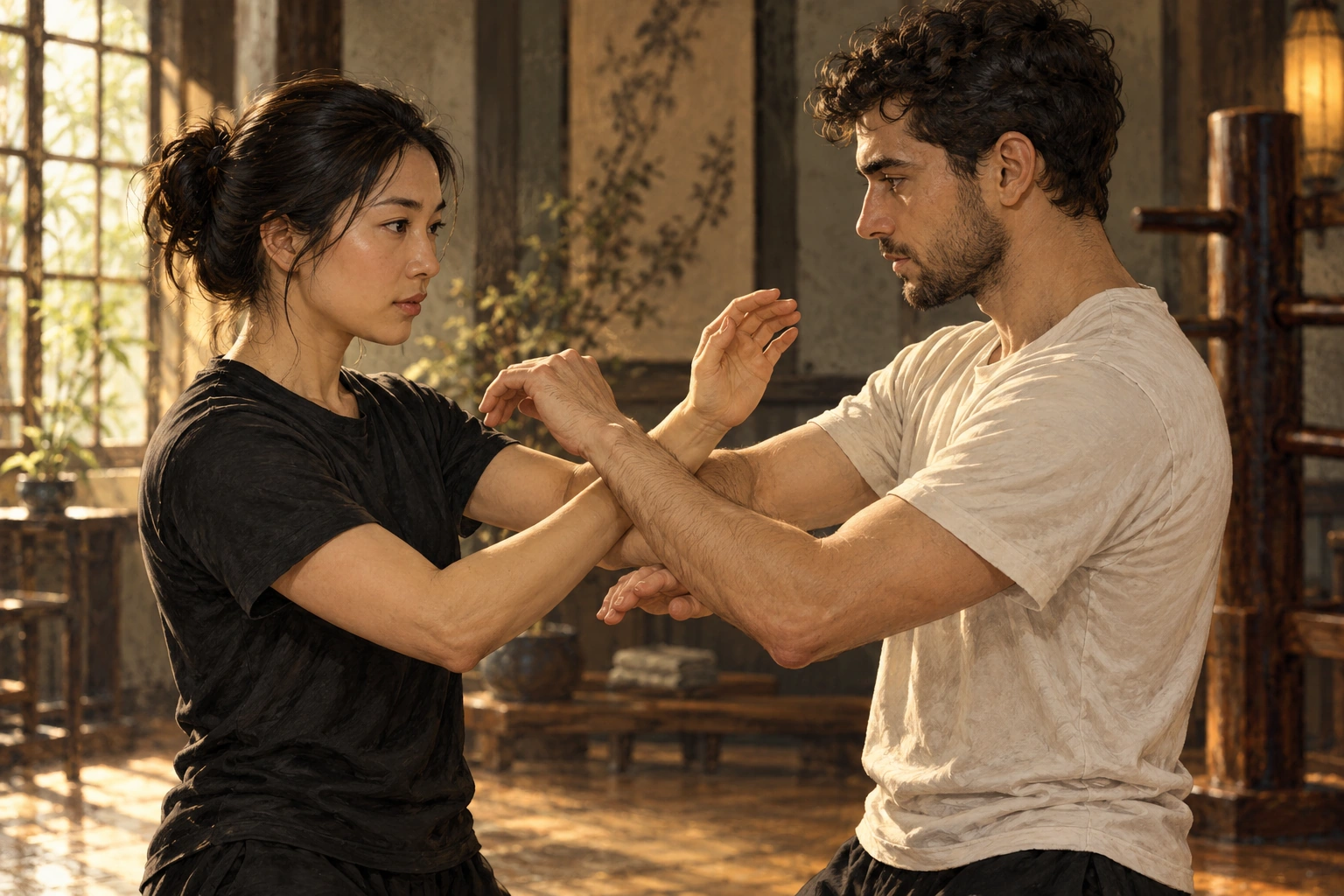
A drill built around contact
Chi sao, often translated as sticky hands, is a partner exercise associated with Wing Chun. The schools consulted describe using contact to notice changes in pressure and respond through positioning. The aim is not simply to keep the arms touching at any cost. It is to explore what information that contact offers and how a partner's action changes the available space. Teaching methods vary between schools and lineages.
A useful boundary
A structured exercise begins with agreed conditions: distance, contact, permitted actions and the level of resistance. Free sparring does not necessarily preserve those conditions. The South Florida Wing Chun academy consulted explicitly distinguishes chi sao from complete sparring and connects it with other practice. Success in the drill therefore cannot, by itself, establish that someone can handle every striking exchange or self-defence situation. School descriptions explain their teaching intentions; they are not controlled scientific proof of universal effectiveness.
Questions worth asking in class
Ask your instructor what the current exercise is meant to develop, what your partner is allowed to change and how you know you have improved. Start with the agreed intensity and keep your partner's control and safety in view. Later, ask how the lesson connects with footwork, entering range and practice with less predictable responses. That gives the drill a clear place in training without turning it into either a magic solution or something to dismiss after watching one internet clip.