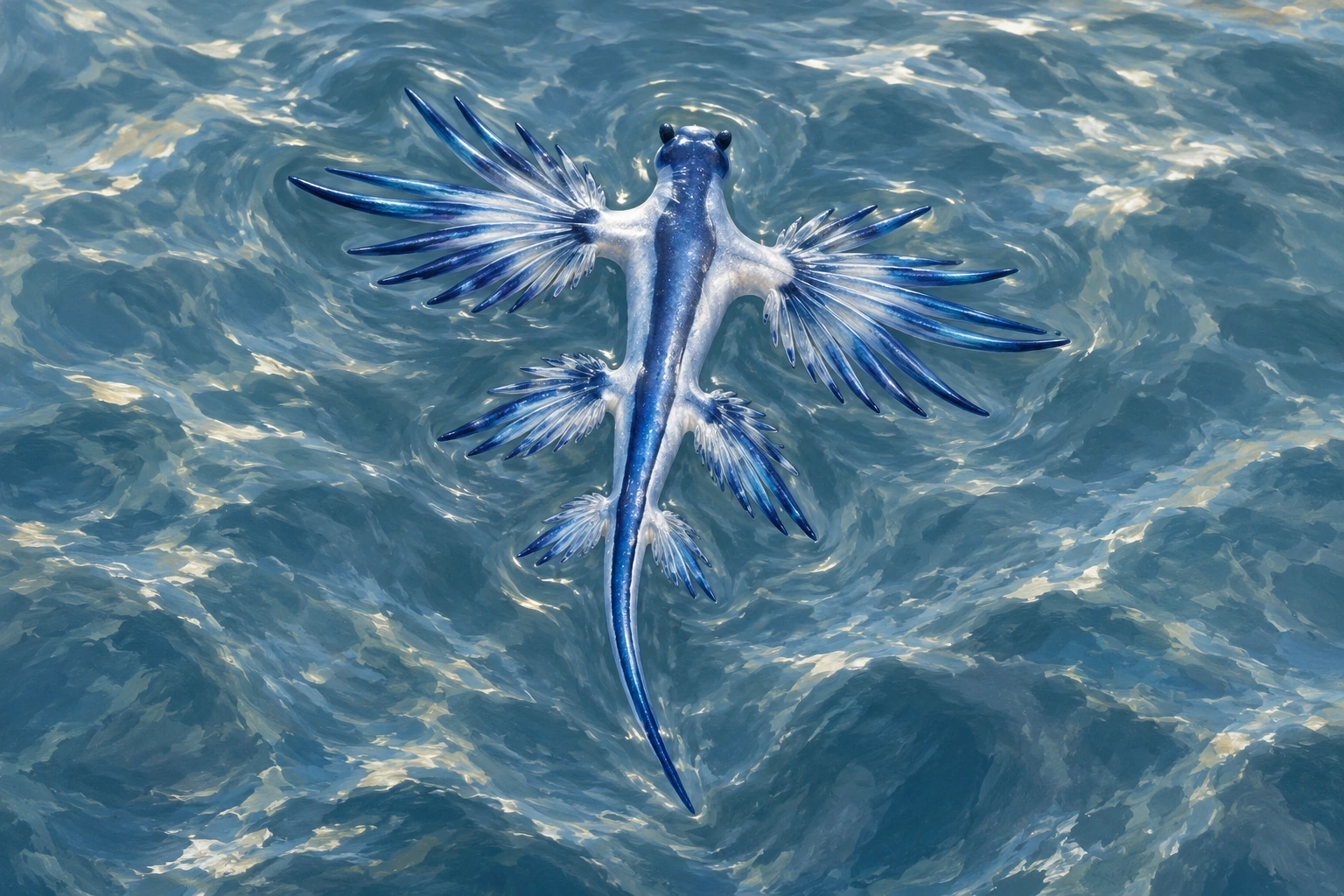
A dragon measured in centimetres
Its silhouette could belong to a fantasy creature, but Glaucus atlanticus is a nudibranch: a soft-bodied marine mollusc without an external shell. Oceana describes a length of about 2.5 centimetres. The Australian Museum’s Sea Slug Forum also documents larger specimens. To picture its scale, think centimetres rather than the impressive size suggested by a macro photograph.
Living upside down
The Australian Museum’s account explains that it floats upside down, partly supported by a gas bubble in its stomach. The blue side visible from above is its ventral surface, including the foot. Its silvery-grey dorsal surface faces into the water. This combination helps camouflage it from observers above and below. Winds and currents carry these surface animals, which is why particular winds can leave them stranded on a beach.
Defence borrowed from prey
Its prey includes Physalia, known as the Portuguese man-of-war or bluebottle. Glaucus can retain stinging cells from prey in structures at the tips of its cerata, the projections along its body. These are neither wings nor legs. A delicate appearance does not make it suitable for handling: the museum describes stings associated with contact. If you find one, observe without picking it up, and avoid handling the organisms stranded alongside it too.
Look beyond the fantasy
In Stranger Animals, Blue Dragon draws on this real species. To recognise it better, examine the body line, groups of projections and orientation in the water. An illustration can emphasise its shape, but does not establish a specimen’s size or where it was found. Learning about the animal offers something more interesting than a monster label: it reveals how a small creature can live at a boundary as exposed as the ocean surface.