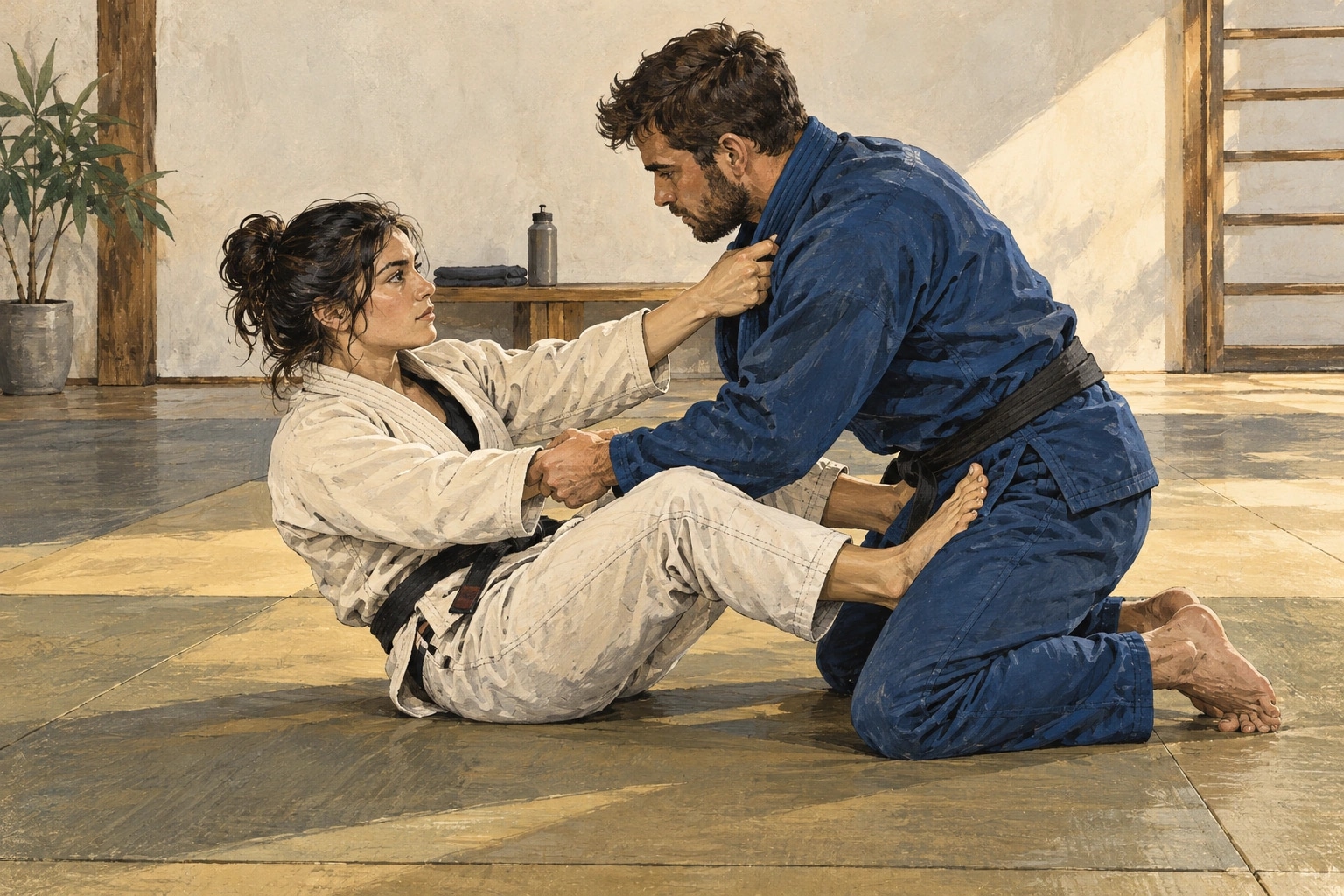
The action begins before the fall
In Brazilian jiu-jitsu, seeing someone move from bottom to top is not enough to identify a scoring sweep. Section 4.6 of the IBJJF rulebook, version 6.1 of 2024 available in its official library, requires a start from guard or half guard and a reversal completed with the relevant control. The starting position matters as much as the finish. This article covers IBJJF; other organizations may use different criteria.
Guard, reversal and control
The basic case earns 2 points: the bottom athlete, with the opponent in guard or half guard, reverses the position, puts the opponent underneath and holds that situation for 3 seconds. Imagine a sequence starting in closed guard: you unbalance the opponent, come on top and stabilize. Compare that with escaping from underneath mount and ending on top without first recovering guard. That second action can greatly improve your position, but alone it does not meet the starting requirement for those two sweep points.
Different finishing positions
The rules also cover an opponent finishing on all fours: controlling their back without hooks can score, provided at least one of their knees stays on the ground for 3 seconds. They also describe standing up from guard or half guard, putting the opponent down and retaining the grips needed to control them for that time. These are rulebook examples, not an exhaustive list of possible situations.
A useful way to review your matches
Pause a video at three moments: the starting position, the reversal and stabilization. Ask what happened at each before debating the scoreboard. Article 3 also states that if you reach a scoring position while caught in a submission, you must escape and stabilize for 3 seconds to receive points. Improving position remains valuable even without a score: separating the two helps both training and understanding competition.